

Football Rules for Beginners: The Complete Starter Guide
I still remember the first time I properly sat down to watch a football match. Someone shouted “Offside!” and the whole stadium groaned, while I just sat there thinking, “Offside from what, exactly?” If that sounds familiar, you’re in the right place.
This guide is my attempt to break down football rules for beginners in a way that actually makes sense — without sounding like I copied and pasted from a rulebook nobody enjoys reading. Think of this as a friendly explainer from one fan to another, not an official law document (for that, you’ll want IFAB or FIFA, and I’ll link those later).
By the end of this article, you’ll understand how a match works, what counts as a goal, why players sometimes seem to “disappear” for being offside, what those colourful cards really mean, and how to follow a game like someone who’s been watching for years — even if this is your first time.
What Is Football and How It Works
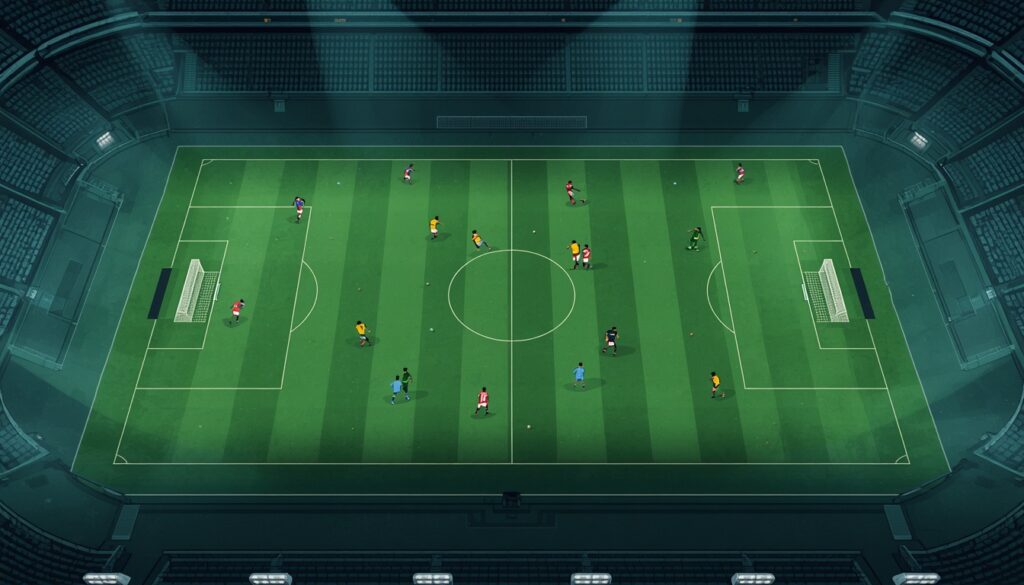
At its core, football (or soccer, if you’re in the US, Canada, or a few other places) is refreshingly simple. Two teams. One ball. Eleven players each side. The goal — literally — is to get the ball into the opponent’s net more times than they get it into yours.
A standard match lasts 90 minutes, split into two 45-minute halves, with a short break in between. On top of that, the referee adds “stoppage time” to make up for delays – injuries, substitutions, time-wasting, you name it. So when you see “90+4” on the screen, that’s not a glitch; it just means four extra minutes are being played.
Whoever scores more goals by the final whistle wins. If it’s level, depending on the competition, the match might end in a draw, or it could go to extra time and penalties — which, as any football fan will tell you, is where hearts are either broken or made.
What I love about this simplicity is that it’s the same basic concept whether you’re watching a Sunday league match in your local park or a Champions League final. The scale changes; the idea doesn’t.
Basic Football Rules Explained
Now let’s get into the basic football rules that actually shape how a match plays out. I’ll keep this beginner-friendly, because honestly, some of these rules confused me for years too.

Starting the Game
Every match starts with a kick-off from the centre of the pitch. One team kicks the ball, usually passing it backward or sideways to a teammate, and play begins.
Kick-offs also happen after a goal is scored — the team that conceded gets to restart play. At half-time, the team that didn’t take the first kick-off gets to take it for the second half. Small detail, but it’s one of those things that makes sense once you notice it.
Scoring Goals
This is the fun part. A goal is scored when the entire ball crosses the goal line, between the posts and under the crossbar. Not “close enough” — the whole ball has to be over the line.
It doesn’t matter who scores it – striker, defender, or even an unfortunate own goal off someone’s shin. If it crosses the line legally (without breaking another rule like offside or a foul), it counts. This is also where goal-line technology and VAR come in, especially in professional football, to confirm those tight calls.
Offside Rule (Simple Explanation)
Ah, the offside rule — probably the most debated rule in football rules-explained content everywhere, and for good reason.
Here’s the simplified version: an attacking player is offside if they’re nearer to the opponent’s goal line than both the ball and the second-last opponent (usually the last defender, since the goalkeeper is often the last one) at the moment the ball is played to them.
In plain terms, if a player is sneaking in behind the defence before the ball is even passed to them, they’re likely offside. It’s there to stop players from just camping out near the goal waiting for a free tap-in. Once you start watching for it a few times, it clicks much faster than it sounds.
Fouls and Free Kicks
Fouls happen when a player breaks the rules in how they challenge for the ball — things like tripping, pushing, holding, or tackling recklessly. When a foul happens, the referee usually awards a free kick to the other team from the spot where it occurred.
If the foul happens inside the penalty area (the box around the goal) by the defending team, it results in a penalty kick instead – one of the most nerve-wracking moments in football, for players and fans alike.
Yellow and Red Cards
This is football’s way of keeping discipline in check. A yellow card is a formal warning for things like rough fouls, time-wasting, or arguing with the referee. Two yellow cards in the same match equal a red card.
A red card means the player is sent off immediately, and their team has to continue with one fewer player for the rest of the match — no substitutions allowed to replace them. It’s a big moment in any game, and honestly, it can completely change the outcome of a match in seconds.
Key Positions and Roles
Understanding Where Everyone Fits
One of the easiest ways to follow a match is to understand what each player is actually trying to do out there. Once you know the roles, the chaos starts to look like organised chaos — which, let’s be honest, is still chaos, but the fun kind.
Positions
- Goalkeeper — The last line of defence. Their job is to stop the ball from entering the goal, and they’re the only player allowed to use their hands (within their own penalty area). A great goalkeeper can single-handedly keep a team in a match.
- Defenders — Positioned mainly to stop opposition attacks, defenders mark forwards, win tackles, and clear the ball away from danger. Center-backs deal with central threats, while full-backs cover the wings and increasingly join attacks too.
- Midfielders — The connectors of the team. Midfielders link defence and attack, control the tempo of the game, and often do the unglamorous running that fans only appreciate after watching enough matches.
- Forwards — The players whose main job is to score goals. Strikers, wingers, and attacking players generally fall into this category, and they’re usually the ones who get the loudest cheers (and the harshest criticism).
Simple Match Flow (How a Game Feels)
Here’s how a typical match actually feels once you understand how to play football at a basic level.
The first 15–20 minutes are usually about teams “feeling each other out” — testing where the spaces are, who’s pressing hard, and who looks nervous. Then there’s usually a spell where one team starts dominating possession, even if it doesn’t always show on the scoreboard.
The second half often feels different. Tactics shift, substitutions come in, and tired legs start making mistakes — which is exactly why so many goals happen in the final 20–30 minutes of matches.
Here’s my slightly opinionated take: the last 10 minutes of a close match are the best 10 minutes in all of sport. Tensions are high, mistakes are amplified, and one moment of brilliance — or madness — can flip everything. I don’t think any other sport compresses that much emotion into such a short window quite like football does.
Beginner Tips to Understand Football Faster
If you’re trying to get into football quickly, here’s what actually helped me (and friends I’ve introduced to the game):
Watch with commentary, not just highlights. Commentary helps explain decisions in real time, especially things like offside calls, fouls, and tactical changes.
Follow one team first. It’s much easier to learn the rules and rhythm of the game when you actually care about the outcome. Pick a club — local, international, doesn’t matter — and follow their journey.
Focus on one player per match. Instead of trying to watch all 22 players, pick one and follow their movement for 10–15 minutes. You’ll start noticing positioning, decision-making, and effort levels much faster.
Don’t stress about every rule on day one. You don’t need to memorise the entire rulebook before enjoying a match. Most fans — including lifelong ones — are still figuring out the finer points of offside.
Watch big matches with friends or online communities. Football is more fun (and easier to understand) when someone nearby is reacting too—whether that’s at a stadium, a local café, or in an online fan group at 1 AM IST during a European night game.
Want to know the World Cup 2026 Travel Guide for Fans? [Click here]
Final Thoughts
Football can look intimidating from the outside — fast, noisy, and full of unwritten rules everyone seems to already know. But once the basics click, it becomes one of the easiest sports in the world to follow, precisely because the core idea is so simple: get the ball in the net more than the other team.
I hope this guide made football rules for beginners feel a little less overwhelming and a lot more exciting. If there’s a rule you still find confusing or a moment in football that completely changed how you saw the game, I’d genuinely love to hear about it in the comments. Share your thoughts — every football fan started exactly where you are right now.
What are the basic football rules for beginners?
The basics include two teams of 11 players, 90-minute matches, and the goal of scoring more goals than your opponent. Key rules cover offside, fouls, free kicks, and yellow/red cards.
How long does a football match last?
A standard match lasts 90 minutes, split into two 45-minute halves, plus added stoppage time. Some competitions include extra time and penalties if scores are level.
What is the offside rule in simple terms?
A player is offside if they’re ahead of the ball and the last defender when the ball is passed to them. It’s designed to stop attackers from waiting near the goal for an easy chance.
Is soccer the same as football?
Yes — “soccer” and “football” refer to the same sport. The term “football” is used globally, while “soccer” is more common in countries like the USA and Canada. So soccer rules for beginners and football rules for beginners are essentially identical.
What’s the difference between a yellow card and a red card?
A yellow card is a warning for a rule violation, while a red card means the player is sent off and can’t be replaced. Two yellow cards in one match also result in a red card.
How can I learn football gameplay basics quickly?
Watch matches with commentary, follow one team or player closely, and don’t worry about memorizing every rule immediately. Understanding builds naturally the more you watch.